

www.missaosalesiana.org.br
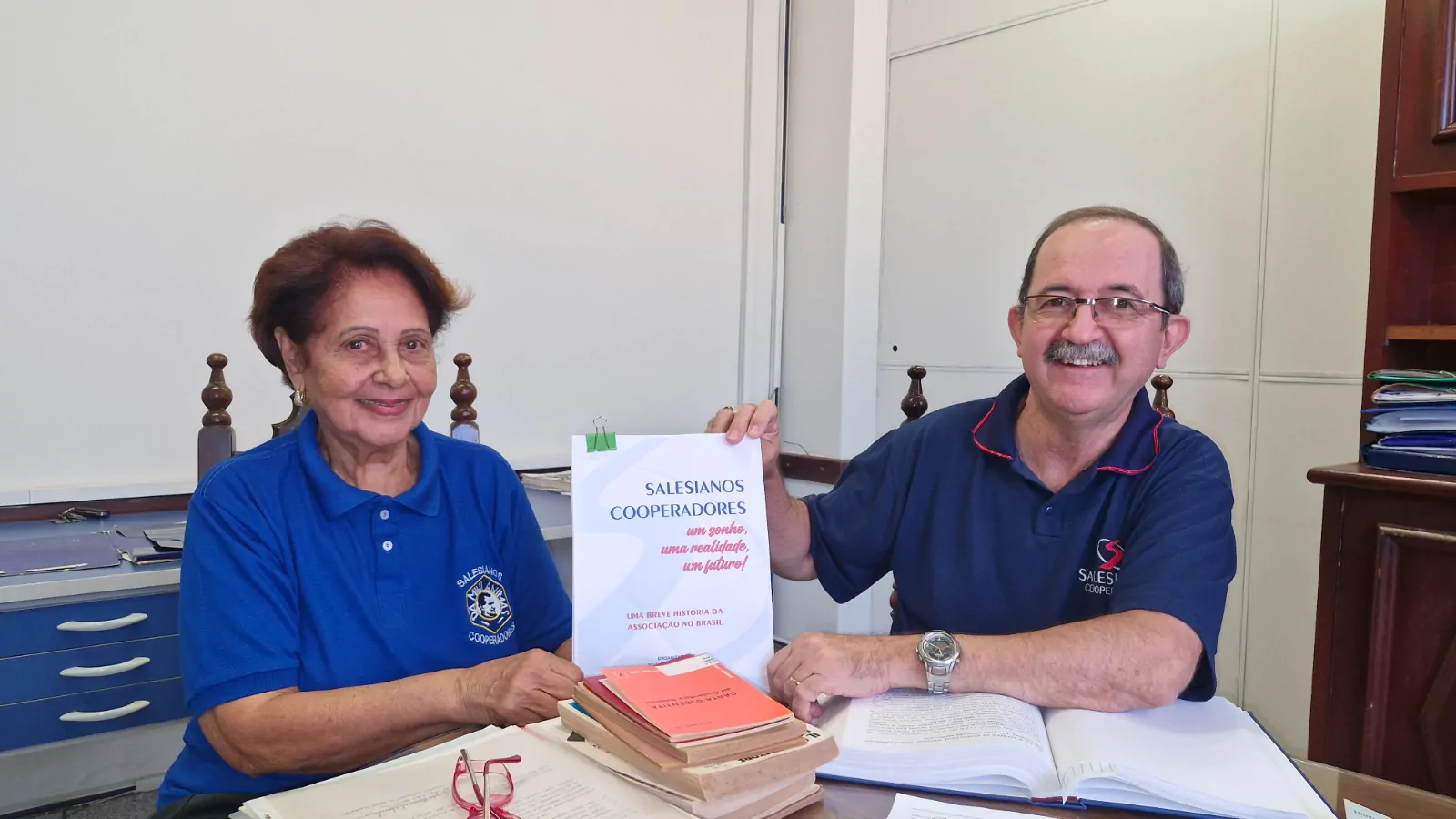
The Salesian Cooperators Margarida Queiroz Pereira and Luiz Marcos Schatzmann return to Casa São José, provincial headquarters of Missão Salesiana de Mato Grosso, in Campo Grande. They will carry out another stage of research on the career of Salesian Cooperators in Brazil. An initiative, started two years ago, seeks to gather historical records of the association founded by São João Bosco.“I am here at Missão Salesiana doing a job as a former Regional Councilor of Brazil, invited by our current consultant, Darlele,” Margarida stated. Secondly, the research addresses the 150 years of the foundation of the Association and maps its evolution from its origins to the present.“We need help from all provinces so that this journey is completed in a timely manner.”
Stages of the investigation include files from all Brazilian inspections
Together I visited archives in São Paulo, Porto Alegre, Barbacena and Campo Grande. “Já minhamos um pouquinho em São Paulo, uma investigation nos arquivos da Inspetoria Salesiana de São Paulo, de Porto Alegre e também em Belo Horizonte”, said Luiz Marcos. In Campo Grande, this is my second visit this year. Margarida reinforced that the biggest challenge is in obtaining documents from the provinces.”Each province has all its own documentation. And no better than the coordinators to prepare isso e nos passar,” he explained. He reinforced that the conclusion of work depends on the collaboration of local leaders.
You discover what happened before the arrival of the Salesians
During the investigation, Luiz Marcos located records of the actions of two cooperators even before the formal founding of the association in various cities.“The history of two coordinators in Brazil has never seen the pre-foundation period,” he said. He cited Salvador as an example: “We have very clear evidence of cooperators who built the entire structure, and then the Salesians settled in the city.”In Rio de Janeiro, in the first house of the congregation, and in Campo Grande, at the initial stage two leigos are possible to consolidate the miss.“They will return to Missão Salesiana conformed and we will look for funds so that this work can be advanced,” he concluded.
Final document aims to inspire new vocations
The team aims to bring together the data in a story entitled ‘A dream, a reality, a future’. The text should offer a brief history of the association, based on discoveries.“There is a lot to be told, a lot of rich elements,” commented Luiz Marcos. He allows other investigators to continue their work.“Who knows, a volume 2, 3, 4, 5… there is a very great wealth.”The document also seeks to inspire new vocations.“We want, in reference to this historical reality, someone to say: ‘I can also be part of it,’” Luiz said.
Association recognizes herança left by Dom Bosco
Margarida highlighted congresses held back in 1919, in Cuiabá and São Paulo, and highlights the change in understanding regarding the missing two cooperators.“I didn’t start, we were considered Salesian collaborators,” he stated. As time went on, the association became seen as corporate in the future with the young people.“It is not just about collaborating financially, but rather working directly with young people in search of a better life.”It reinforced integration with the consecrated Salesians and with the Filhas de Maria Auxiliadora.”Associação Dom Bosco created, but not only the leigos. Our journey is together,” he concluded.
Spirituality sustains the present moment
At the end of the interview, Luiz Marcos reflected on the importance of Dom Bosco’s charisma in today’s society.“A Associação dos Salesianos Cooperadores draws the charisma of São João Bosco for the Church and for the society,” he stated. He explained that, from the very beginning, the association sought to promote morals and good costumes in civil society.“We are blessed Catholic Christians who trace the spirituality of Dom Bosco as heritage,” Margarida reinforced. He highlighted the importance of working with young people and building a just society, consistent with the Church’s calling.