

THE CONGRESS THAT SET OUR HEARTS ON “THE NOW”
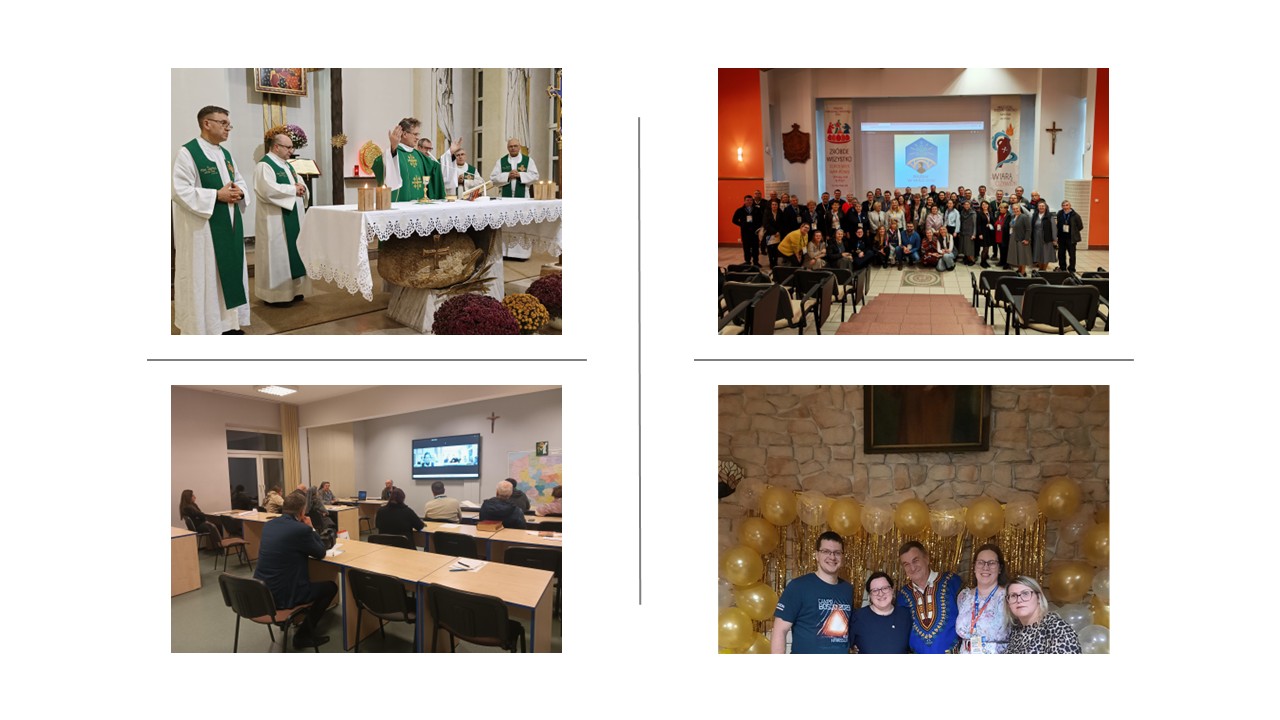
There are events in which one participates not only with the mind, but with the whole self. Kraków, late autumn. The air was cold, yet in the hearts of those present — a fire not born of weather, but of vocation. From 28 to 30 November 2025, within the walls of the Major Seminary of the Salesian Society in Kraków, the Congress of the Salesian Cooperators of the Central and Eastern Europe Region was held under the motto: “Together in the SSW Mission. Strengths and Challenges.” Nearly 50 people gathered — representatives from the four provinces in Poland, as well as from the Czech Republic, Slovakia, Belarus, Ukraine, Russia, Croatia, Slovenia and Hungary. They all came for one reason: to rediscover how to live the charism of St. John Bosco here and now, in a world that needs hope more than ever.
The First Evening: A Eucharist That Opened Hearts
From the very beginning, the Congress revealed how deeply we need one another. When Blažka Merkac, our World Councillor, together with me on behalf of the four Polish provinces, welcomed all participants, I saw in people’s eyes the same mixture of curiosity, hope, and a profound desire for good. For that good which — as Fr. Bosco used to say — “begins in the heart, but lives only when it becomes a gift for others.”
The Congress began with the Eucharist celebrated by the Provincial-designate, Fr. Dariusz Bartocha SDB, with the homily delivered by Fr. Zygmunt Kostka SDB.
It was not merely an opening liturgy — it was an entry into a space of light. In his homily, Fr. Kostka reminded us of something that often slips away in the busyness of everyday life: that the charism of St. John Bosco is not a method, but a spirit — a way of seeing, a choice of love that recognizes good before it grows. He spoke of the fact that “holiness in the Salesian sense is not the heroism of extraordinary moments, but fidelity to small gestures of goodness carried out with heart and consistency.”
His words fell into us like seed: simplicity, truth, the joy of the Gospel — this is the atmosphere in which Salesian Cooperators are meant to breathe. Many admitted later that this homily set the tone of the entire Congress: warm, spiritual, full of light.
The first evening confirmed for me that the Congress was, above all, a meeting of hearts. The Eucharist, shared conversations, laughter at dinner, the “Good Night Talk” … all of it sounded like a confirmation that the Salesian spirit still draws people with simplicity, family spirit, and joy. When Fr. Dariusz Gojko gave his Good Night Talk, I thought that Salesian spirituality has this unusual ability: it awakens gratitude for ordinary things.
The Second Day: Conversations That Become a Path
Saturday morning began with the Eucharist and Morning Prayer prepared by the delegations from Belarus, Russia and Ukraine. The main celebrant, Fr. Provincial Marcin Kaznowski SDB, entered the day with a homily that turned out to be one of the most significant spiritual highlights of the Congress.
In his reflection, he invited us to look at the “Day of the Lord” not through fear or catastrophic visions, but through the lens of the Gospel. He reminded us that although described in apocalyptic language, this day is above all the day of salvation — a moment when a person may see new light, if only one remains watchful.
He spoke of vigilance of the heart, of interpreting the signs of the times, of sensitivity to what God speaks in daily life. “Watch therefore, and pray at all times” — these words of Jesus became, in the homily, not a warning but an invitation to maintain inner attentiveness and peace in a world full of uncertainty.
Fr. Kaznowski also reminded us that crises — personal, family, social — can be spaces for a new beginning: “Something comes to an end, but something new has a chance to be born.”
This homily acted as a spiritual compass for Saturday: it calmed, ordered our gaze, and pointed to Jesus who comes not only “someday,” but now, into the heart of every day.
Saturday became a day of intense work — the kind that does not leave one tired but illuminated. Listening to the reports from each country, I saw how different our circumstances are, and yet how deeply our desires align. Our region faces challenges: aging communities, lack of visibility, a generational gap, and at times a lack of full understanding of our role within the Salesian Family. And yet every voice, every testimony, carried the same note: “We want to live the charism; we want to be needed; we want to form and be formed.”
Group Work: A Space Where the Truth of Our ‘Today’ and ‘Tomorrow’ Emerged
The most intense moment of Saturday was group work. It was there — in conversations often very open and sincere — that we voiced what many of our provinces have carried in their hearts for a long time. Hearing our thoughts resonate across different countries and contexts was deeply moving. It became clear that although we differ in culture, Church experience, community history, and social realities, the challenges we face are nearly identical.
Three main areas emerged — someone aptly called them not problems, but signposts. Not to burden us, but to indicate direction for the years to come.
The first area was the identity of the Salesian Cooperators. In many places we still notice that SSW is seen merely as a group of helpers or volunteers, not as a full branch of the Salesian Family possessing its own mission, spirituality, and vocation. At times even some SDB and FMA communities do not fully understand our place and role. Often the topic of being unrecognizable during Salesian Family events resurfaced, the difficulty of being viewed through the lens of volunteerism, and the general lack of clarity about who we actually are.
And yet very concrete proposals arose: more deliberate and active sharing about our vocation, presenting initiatives and testimonies, taking the initiative rather than waiting for invitations, and creating more spaces for deeper cooperation with the SDB, FMA, and other branches of the Salesian Family. For me, this discussion was one of the strongest moments of the day. It touched the heart of our identity — the conviction that if we do not speak for ourselves, others will not know how to work with us. And Don Bosco always saw us as the lay arm of his charism.
The second area concerned cooperation with young people and the growing generational gap. This topic appeared in every group, regardless of whether the speakers were from Poland, Slovenia, the Czech Republic, Belarus, or Ukraine. Everywhere we see the same concerns: aging communities, lack of recognition of the SSW among young people, and difficulties arising from generational differences that sometimes hinder collaboration. Yet this point also brought exceptional hope. Participants proposed creating real spaces for cooperation with youth, entrusting them with meaningful responsibilities, listening to their opinions, and inviting them to co-create initiatives. Across all countries, the desire was the same: that our communities be living spaces — places of dialogue and mutual learning.
The third area concerned member activation and economic solidarity. A difficult yet very necessary topic, close to the everyday life of many provinces. Many of us struggle with low engagement of some members, weak integration between local centers, financial instability, and at times lack of transparency. Here too, specific, implementable proposals appeared: diagnosing causes of inactivity, creating anonymous surveys, maintaining regular communication and personal invitations to collaborate, deepening formation, increasing financial transparency, seeking new sources of funding, and strengthening economic solidarity both within provinces and across the region.
This part of the Congress was exceptional. Very practical, very “hands-on,” yet full of spirit because it touched the real life of our communities. The proposals were sensible, realistic, and anchored not in structures, but in mission.
The afternoon walk through Kraków and the rosary led by Sr. Maja Dolenec showed that work and spirituality are not two separate paths. In the Salesian style, they always go together. Wisdom and prayer. Analysis and contemplation. Discernment and joy.
Meeting of the World Delegate of the FMA, sr. Lucrecia Uribe: A Decision That Gives Birth to the Future
Saturday also included an important meeting of the World Delegate of the FMA, sr. Lucrecia Uribe. For me, it was one of the key moments of the Congress. In a sincere conversation full of realism yet also hope, we confirmed that our region needs a secretariat. Because although each one of us gives a great deal, there comes a moment when goodwill is not enough. We need structure — people who can provide real support to our Councillor, Blažka. This was not just an administrative decision. It was an expression of maturity: the awareness that co-responsibility also requires tools.
An Evening of Joy — Salesian “Andrzejki”
After a full day of work came a breath of fresh air — one that did not merely relax but built community. The Good Night Talk delivered by Fr. Henryk Bonkowski SDB turned into a true journey. He brought us into the world of mission countries: their colors, songs, rhythms and gestures. We learned mission dances, songs, and calls — simple yet full of joy, warmth, and natural oratory energy. Guitar, colorful props, spontaneity — all created an atmosphere reminding us that joy is Don Bosco’s language.
And yet, amidst all the enthusiasm, there was a moment of silence that resonated even more deeply. Fr. Henryk led us in prayer to Mary Immaculate — on the second day of the novena in her honor. This short pause was like candlelight: delicate, focused, moving in its simplicity.
Only after this prayer did the Andrzejki evening begin — a natural transition from contemplation to joy, from silence to celebration. In the conversations and festivities that followed, something new was sprouting within us. Courage, perhaps? A sense of shared direction? Or simply — hope.
Sunday Meeting with Sr. Lucrecia — An Invitation That Opens Horizons
Sunday brought a moment of reflection and summary. During the meeting with Sr. Lucrecia, this time open to all participants, we heard an invitation that stirred many hearts. It was a call to attend the World Congress in Rome, organized in the jubilee year marking the 150th anniversary of the founding of the Association of Salesian Cooperators. Sr. Lucrecia spoke with great simplicity: that we need one another, that we need to meet both “large” and “small,” that the life of the charism is born from the experience of the entire global community.
In many of us, a thought awakened: “This is not the time to shrink. It is the time to grow.” Listening to her, I felt as if doors were opening — not only to an event, but to a new stage of our presence in the world, in the Church, and in the Salesian Family.
The homilies and short reflections accompanying us through the three days were like steps along a path: Fr. Zygmunt reminded us of the reality of Jesus who comes now; Fr. Marcin Kaznowski (during Saturday’s Eucharist) helped us see the “Day of the Lord” not as an apocalyptic image but as a call to vigilance and renewal; Fr. Piotr Lorek urged us to “ascend the mountain of the Lord” — to take on the effort of climbing that purifies, unites, and allows us to see the world from God’s perspective. Each message shone like a point of light on the map of our future decisions.
A Congress That Did Not End — but Began
As we returned home, I felt that this Congress was not merely a gathering of decisions and protocols. It was an experience of a community capable of holding prayer and work together, joy and responsibility. We took with us not only resolutions — about the secretariat, greater visibility, openness to young people — but also the image of a community that, despite challenges, wants to grow in unity.
For me, the most beautiful moments were the simple gestures: smiles after Mass, shared walks, the Good Night Talks, evening conversations over tea. These showed that the Salesian family is alive — not as an idea, but as daily presence and care. And this care is what we carry back to our provinces, ready to continue building the future of the SSW — with hope, courage, and fidelity to the vocation of St. John Bosco.
Because if anything became clear at this Congress, it is that the future of the SSW will not arise by accident. It will be born of community. Of co-responsibility. Of deeply rooted hope. And this weekend in Kraków was one of those moments when that hope received new life.
Agata K. Kołakowska
Provincial Coordinator of the Salesian Cooperators
Wrocław Province — Poland